
Register here to attend.
We will also be enabling virtual participation for much of the program! You can register to attend remotely here instead.
This year’s social ecology summer intensive course is being hosted in partnership with Native Roots Networkand the Peoples’ Network for Land and Liberation. From June 5 to 11, we will gather at Native Roots Network’s Traditional Ecological Knowledge land lab Wenem To•s in Shasta County, just outside Redding, California. This is an in-person, in-depth gathering in which participants dive headfirst into the ideas and practices of social ecology: grassroots organizing, ecological philosophy, direct democracy, and revolutionary social transformation.
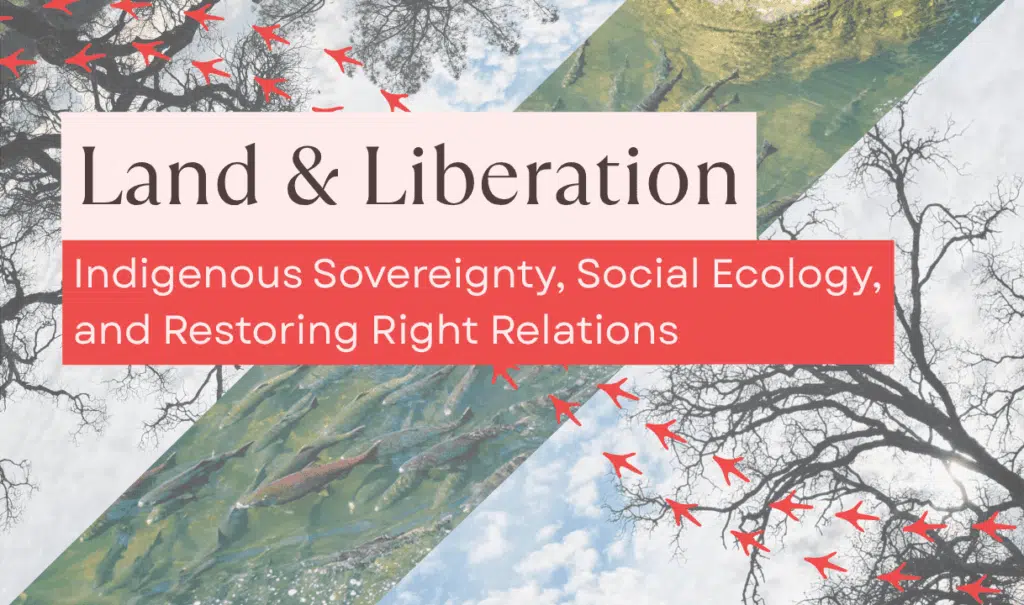
This year’s theme is Land and Liberation: Indigenous Sovereignty, Social Ecology, and Restoring Right Relations. We are drawn to the many roles of land in the process of social transformation. It is both a means for cultivating bases of power to resist the present system and a source of responsibility for cultivating new relationships to the more-than-human world. How we must relate to the land, ecologically and politically, draws indigenous struggle and social ecology together.
For Native Roots Network, this requires what they name “(K)new” practices and relations: at the same time an imaginative step into our unknown future and a return to ancestral lifeways. This notion shapes our thinking about entering right relationship with nature, about transforming our culture and society, about revolutionary political struggle—looking to our history as we create our future. The very language of “revolution” itself contains this same sensibility: the word means the overthrow of existing social structures in a great forward leap, and a return, in the astronomical sense of a planet completing its revolution around the sun and rearriving at an earlier position. Through the land practices we will focus upon in this week, we in this same sense seek to revolutionize our relationships to the land—and one another.
Over the course of this program, we will explore Indigenous initiatives to regenerate their ancestral lands and waterways, “Acornomics” as a solidarity economy model, Traditional Ecological Knowledge, dual power, questions of revolutionary organization, and much more, while building lasting relationships. Throughout this week of collective study and collective discussion, we will be asking ourselves and one another: What is the relationship between land and liberation? How do we build a new society while the world is burning?
There are many more details to come regarding specific programming content, schedule, and housing. (Note: when registering, please leave ticked the box reading “Allow the Institute for Social Ecology to contact me.” This is necessary for you to receive essential updates about the event.)
Registration fee is on a sliding scale—standard registration is what we estimate will be our average per-person cost for putting on this event. Anything you can contribute beyond that will help us cover for those who need a discounted registration. Low-cost bunk-style housing is available though limited, along with free camping for all participants. Registration covers all meals. We plan to organize airport and bus station pick-ups for those arriving in Redding by air travel or public transportation. Invite your friends and comrades, and we hope you can join us! This gathering is intended for the budding activist wholly new to these ideas and the veteran movement intellectual alike.
Program details below in draft form, subject to ongoing change. We are thrilled to have you join us! Reach out to social-ecology@mail.mayfirst.org with any questions.
~ The Institute for Social Ecology, Native Roots Network, and the Peoples’ Network for Land and Liberation
Program Schedule (subject to change)
Friday, June 5
11am-1pm: Arrival and check-in
1pm-3pm: Opening circle and welcome ceremony
3pm-4pm: Wenem To•s tour
4pm-6pm: Introduction to Social Ecology
6pm-7:30pm: Dinner
Saturday, June 6
8am-9:30am: Breakfast
9:30am-10am: Morning assembly
10am-12pm: Acornomics
12pm-1:30pm: Lunch
1:30-3:30pm: Zapatismo and Pluriversal Ontology
4pm-6pm: Philosophy of Social Ecology
6pm-7:30pm: Dinner
8pm-10pm: Musical performance
Sunday, June 7
8am-9:30am: Breakfast
9:30am-10am: Morning assembly
10am-12pm: Dual Power and the State
12pm-1:30pm: Lunch
1:30-3:30pm: Peoples’ Network for Land and Liberation
4pm-6pm: Tribal Politics
6pm-7:30pm: Dinner
8:00pm-10pm: Climate Cafe
Monday, June 8
8am-9:30am: Breakfast
9:30am-10am: Morning assembly
10am-12:30pm: The Liberation and Restoration of the Klamath River
12:30pm-1:30pm: Lunch
1:30-3:30pm: Decolonizing Kurdistan
4pm-6pm: Traditional Ecological Knowledge
6pm-7:30pm: Dinner
Tuesday, June 9
8am-9:30am: Breakfast
9:30am-10am: Morning assembly
10am-12:30pm: Fire Ecology of the West
12:30pm-1:30pm: Lunch
1:30-3:30pm: Self-organized sessions
4pm-6pm: TBD
6pm-7:30pm: Dinner
Wednesday, June 10
8am-9:30am: Breakfast
9:30am-10am: Morning assembly
10am-12:30pm: Self-organized sessions
12:30pm-1:30pm: Lunch
1:30-3:30pm: Bolshevizing Anarchism, Anarchizing Bolshevism: The New Paradigm
4pm-6pm: TBD
6pm-7:30pm: Dinner
Thursday, June 11:
8am-9:30am: Breakfast
10am-12pm: Meeting the Moment
12pm-1pm: Lunch
1pm-2:30pm: Closing circle